
800 Companies, 20 Meetings. Who Actually Matters?
Companies preparing for industry events face a familiar problem. There are hundreds of companies in the room and time to meet a fraction of them. The question is never "who is here" - it is "who actually matters, and why."
This is the problem Roman Chubaruk, our COO decided to solve properly.
The solution
Roman built an AI-powered research tool that pulls financial data, news, and job postings for every company at an upcoming event. It scores each one based on signals that matter for sales - growth indicators, hiring patterns, recent developments - and produces a prioritized list of 100 companies with clear recommendations on who to meet first and why.
The goal was simple: turn 800 companies into 100 interesting companies and 20 right conversations.
The first version
The first version was fully automated. The idea was straightforward - feed the data in, let the system decide, get the list out.
Accuracy: around 30-40%. A list you can only half-trust is barely better than no list at all.
Roman describes it as an expert system rather than an automation tool - one where human interaction throughout the process is what makes the results usable. The triggers are tied to real signals: news, hiring patterns, and financial shifts. The system analyses, but a person decides.
What fixed it
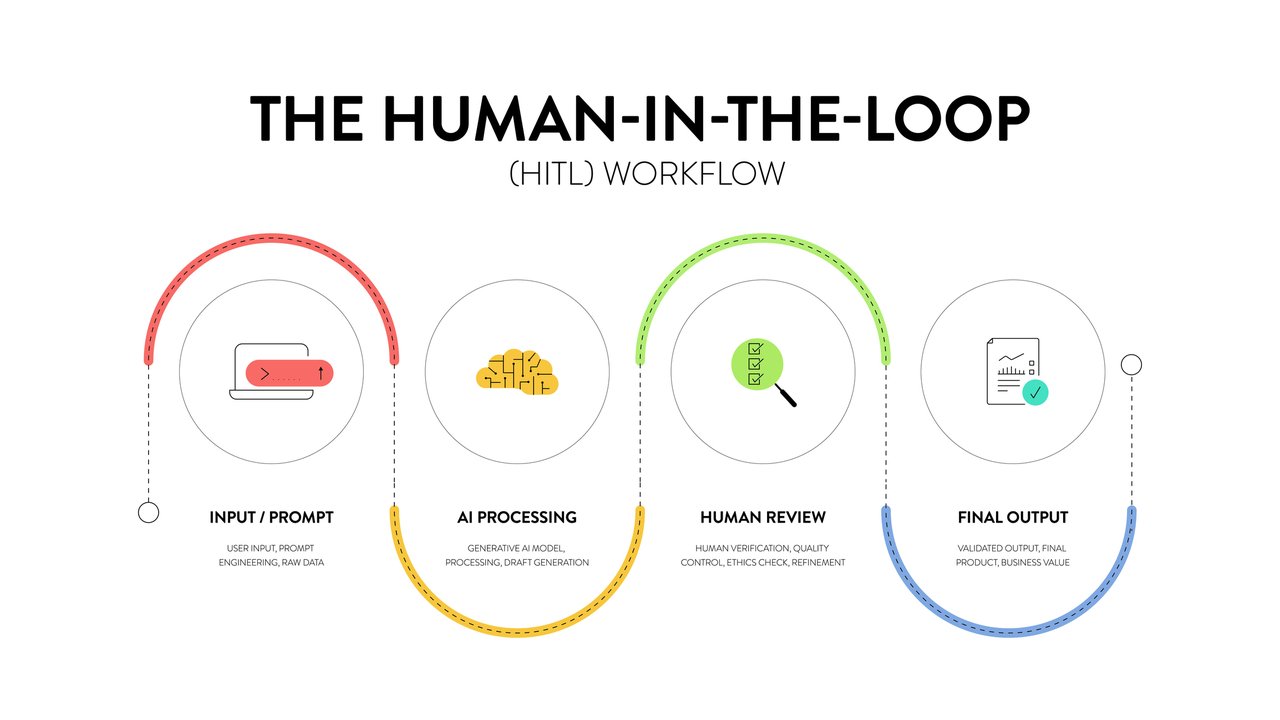
The fix was not a better model. It was not more data. It was keeping a human involved throughout the process - not just at the end to review results, but at key points along the way. Someone to steer the analysis, correct the direction, and make the judgment calls that AI simply cannot make.
This approach has a name: Human in the Loop. The idea is that some decisions require human judgment not as a final check, but as an active part of the process.
With that change, accuracy jumped to 90-95%.
Human in the Loop
What this means in practice :
A fully automated system is faster but brittle. It optimizes what it can measure and misses what it cannot. A human brings context, nuance, and the ability to recognize when something feels off even if the data looks clean.
The combination - AI doing the heavy lifting, a human steering at the right moments - is where the real value is.
The bigger question
The question is not whether AI can do this. It is where AI needs a human to actually be useful. That distinction matters more than most conversations about AI tend to acknowledge.
We built this solution because we needed to simplify and improve the efficiency of our own process. We still use it today and have continuously refined it over time.
Do you want to know more about this way of solving challenges? Please don't hesitate to contact us, we love to help.
